
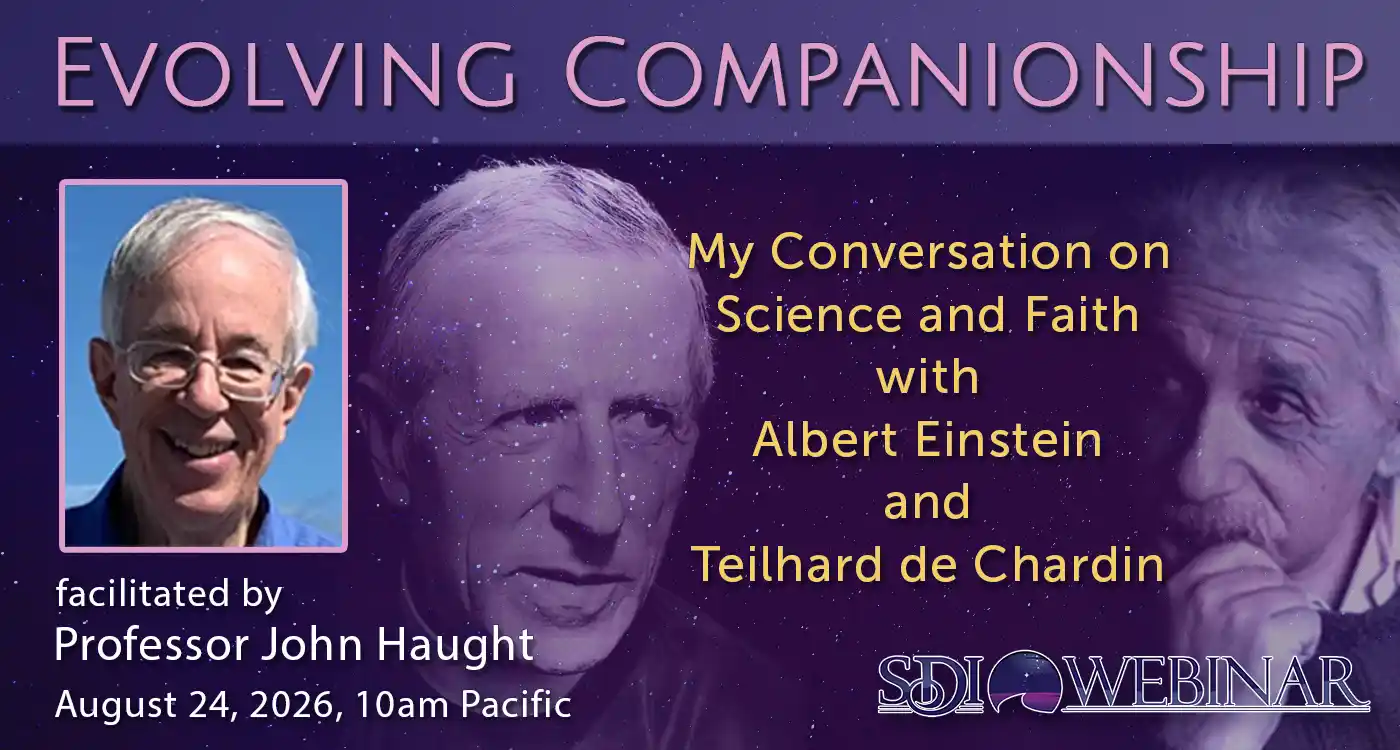

Evolving Companionship
My Conversation on Science and Faith with Albert Einstein and Teilhard de Chardin
A Special One-Session Teaching from Distinguished Professor John Haught
Presenters

John Haught
Dates
August 24, 2026,
10am P / 1pm E
Find your own local time here.
Duration
90 minutes (total)
Webinar will be recorded.
“The most empowering relationships are those in which each partner lifts the other to a higher possession of their own being.”
—Pierre Teilhard de Chardin
SDI is delighted to welcome back Distinguished Professor John F. Haught, whose acclaimed 2024 webinar on Pierre Teilhard de Chardin inspired participants across traditions and practice to explore the relationship between science, evolution, spirituality, and companionship.
For this unique offering, Professor Haught writes,
“Although Albert Einstein denied the existence of a personal God, he confessed to being religious, and he thought that good science and right living cannot take place without faith. To understand what he meant by faith, this presentation will place the celebrated physicist in “conversation” with his contemporary, Pierre Teilhard de Chardin. The two scientists had been living in the United States within miles of each other when they both died in the spring of 1955. If they had ever met and been able to talk about science, the universe, time, faith, God, and the meaning of life, how would the conversation have gone? This presentation, with the presenter as “moderator,” will attempt to outline points of agreement and disagreement between the two great scientists and religious thinkers, as one way to think of the relationship of science to theology today.”
Join us for a fascinating exploration of where scientific discovery and spiritual wisdom converge, and what these two remarkable thinkers still have to teach us about living faithfully in an evolving universe.
“We are not physical beings having a spiritual experience; we are spiritual beings having a physical experience. It doesn’t matter if the water is cold or warm if you’re going to have to wade through it anyway. Remain true to yourself, but move ever upward toward greater consciousness and greater love!”
—Pierre Teilhard de Chardin
About Albert Einstein
Albert Einstein (1879-1955) was one of the most influential scientists in human history. Born in Ulm, Germany, in 1879, Einstein transformed our understanding of the universe through his groundbreaking theories of special and general relativity, which revealed that space, time, matter, and energy are deeply interconnected. His famous equation, E = mc², became one of the most recognizable scientific formulas in the world.
Awarded the Nobel Prize in Physics in 1921 for his work on the photoelectric effect, Einstein’s discoveries helped lay the foundations for modern physics and continue to shape scientific inquiry today.
Beyond his scientific achievements, Einstein was deeply concerned with questions of meaning, morality, and humanity’s place in the cosmos. Although he rejected belief in a personal God who intervenes in human affairs, he frequently described himself as religious. His spirituality was rooted in a profound sense of wonder before the intelligibility and mystery of the universe. Influenced in part by the philosophy of Baruch Spinoza, Einstein spoke of a “cosmic religious feeling”—an awe-filled reverence for the harmony, beauty, and rational order revealed through scientific discovery.
For Einstein, faith did not mean adherence to religious doctrine. Rather, it involved trust that the universe is intelligible and that human beings can participate in the ongoing search for truth. He believed that both science and ethical life require a kind of faith: confidence that reality is meaningful enough to be explored and that human beings are capable of pursuing truth, goodness, and beauty.
Albert Einstein
Credit: Wikipedia
Pierre Teilhard de Chardin
Credit: Wikipedia
About Pierre Teilhard de Chardin
Pierre Teilhard de Chardin, (born May 1, 1881, Sarcenat, France—died April 10, 1955, New York, N.Y., U.S.), was a French Jesuit priest, paleontologist and philosopher. From a scientific perspective, he is best known for having directed the excavations at the Peking man site at Zhoukoudian in 1929. His philosophy was significantly influenced by his scientific work, which he argued helped prove the existence of God. He is known for his theory that mankind is constantly evolving, from multiple perspectives, toward a final spiritual unity that he called the Omega point. His major philosophical works, The Divine Milieu (1957) and The Phenomenon of Man (1955), were written in the 1920s and ’30s.
Teilhard sought an evolutionary metaphysic, and attempted to demonstrate that the most profound philosophical insights can be integrated with modern science, in as much as all physical manifestations point beyond themselves toward the production of more complex, evolved, and perfected unified beings.
Teilhard served in World War I as a stretcher-bearer. He received several citations, and was awarded the Médaille militaire and the Legion of Honor, the highest French order of merit, both military and civil.
His work has significant import for spiritual directors, and the people they companion, interested in the intersection of science and religion.
“The cosmic religious feeling is the strongest and noblest motive for scientific research.”
— Albert Einstein, “Religion and Science,” New York Times Magazine (1930)
When
This single-session webinar series will run on August 24, 2026 at 10am Pacific / 1pm Eastern.
Find your own local time here.
This session will be recorded so you can watch at your convenience.
Presenters
John Haught
John F. Haught is a distinguished theologian, author, and Professor Emeritus of Theology at Georgetown University, internationally recognized for his pioneering work at the intersection of science, evolution, cosmology, and Christian faith. Over a career spanning more than five decades, he has helped shape contemporary conversations about the relationship between religion and science through his teaching, public lectures, and numerous influential books, including God After Darwin, Science and Faith, The New Cosmic Story, and God after Einstein.
Deeply influenced by the thought of Pierre Teilhard de Chardin, Haught explores how evolutionary science can enrich theological understanding and illuminate humanity’s place within an unfolding universe. His contributions to theology and science have earned him numerous honors, including the Owen Garrigan Award in Science and Religion, the Sophia Award for Theological Excellence, and a Lifetime Achievement Award for his work in religion and science.
WATCH JOHN'S INTRO TO THIS SESSION IN THE VIDEO BELOW
Additional Information
- Participants from all spiritual traditions and orientations are welcome in this webinar series as are those with all levels of spiritual experience.
- This single session will run 90 minutes. We understand that the timing of the seminar will not be convenient in every time zone on the planet. For those who have trouble making this time, a recorded copy of each session will be made available to all those who sign up.
- CEU credits are available for all those who participate. SDI will provide a certificate of completion for self-reporting to agencies. More information can be found here: continuing education units (CEUs).
- Scholarships are available for those facing financial hardship. Please apply here.




Reviews
There are no reviews yet.